
You’re Not Imagining This: The Things Chronically Ill People Are Never Taught to Name
A compassionate reflection on the experiences chronically ill people are rarely taught to name—offering language, validation, and community for lives shaped by illness, grief, and survival.
COMMUNITY, LANGUAGE & VALIDATION
Baylie Phillips
2/28/20265 min read
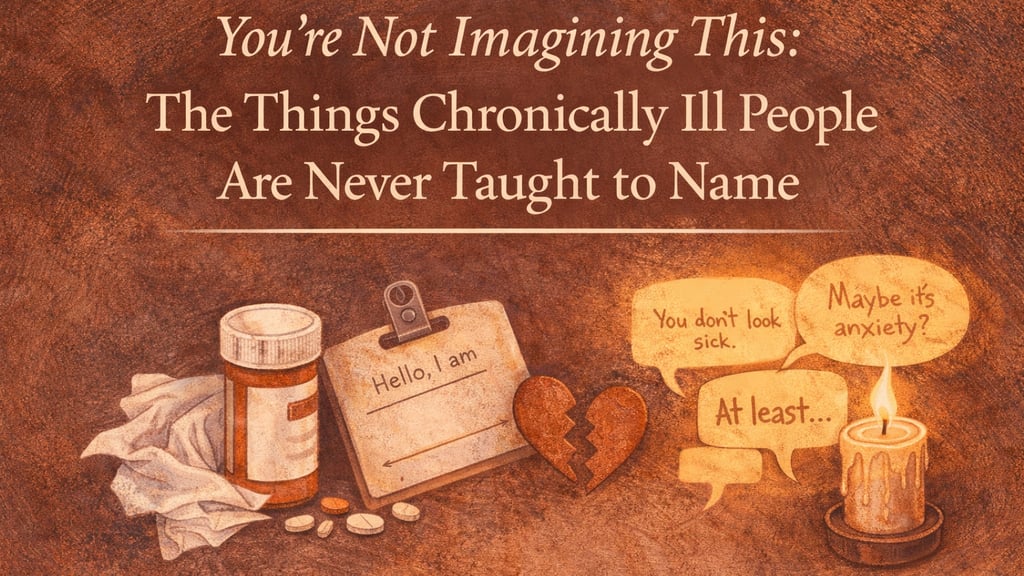
You’re Not Imagining This: The Things Chronically Ill People Are Never Taught to Name
There is a particular kind of loneliness that comes from not having language for what you are living.
It’s not just that you are sick.
It’s that you are sick in ways that don’t fit the stories you were taught.
It’s that your experience doesn’t have a name people recognize, a script others know how to follow, or a timeline anyone can predict.
When there is no language, we assume the problem is us.
This post exists to say: it isn’t.
So many of the hardest parts of chronic illness, disability, medical trauma, and long-term survival are not taught, named, or validated anywhere. They live in the quiet spaces between appointments. In the moments after conversations that didn’t land. In the grief that has no ceremony. In the exhaustion that comes from constantly translating your reality into something others will accept.
This is a place to name those things.
Not to fix them.
Not to resolve them.
But to say them out loud—together.
The Cost of Living Without Language
When you don’t have words for your experience, you internalize it.
You assume:
You’re coping badly
You’re being dramatic
You’re failing at illness
You’re not strong enough
You should be handling this better by now
Without language, pain turns inward. Confusion becomes shame. Grief becomes something you feel privately and apologize for publicly.
Language doesn’t cure suffering—but it changes how it lives inside us.
When something is named, it stops being a personal flaw and becomes a shared human experience. When something is spoken, it becomes survivable in a way silence never allows.
This category exists to offer language where there was none.
Lived Experiences That Deserve Names
1. Grieving Futures That Never Happened
One of the most unacknowledged losses in chronic illness is the loss of imagined futures.
Not dramatic, cinematic dreams—but ordinary ones.
Careers you assumed would unfold.
Bodies you trusted would keep up.
Relationships you thought would be easier.
A sense of continuity you never questioned.
There is no funeral for these losses.
No permission to mourn something “hypothetical.”
So people tell you:
“At least you’re alive.”
“At least it’s not worse.”
“You can still do so much.”
And you nod—while quietly grieving a life that disappeared without warning or closure.
That grief is real.
It deserves language.
It deserves space.
2. Being Functional Enough to Be Expected to Continue—But Sick Enough to Be Drowning
This is one of the most isolating positions to exist in.
You are not visibly incapacitated.
You are not consistently functional.
You exist in a gray space that confuses everyone—including you.
You can show up sometimes.
You can perform competence briefly.
And because you can, you are expected to always.
But what people don’t see is the cost.
The recovery time.
The collapse afterward.
The energy debt that accumulates quietly.
This experience is not inconsistency.
It is fluctuating capacity.
And it is exhausting.
3. Losing Identity Without Closure
Chronic illness doesn’t just change what you can do.
It changes who you are allowed to be.
Roles shift.
Competence is questioned.
Reliability becomes conditional.
Independence becomes complicated.
And yet—no one marks the transition.
You don’t get time to stop and say:
“I am not who I was.”
“I am becoming someone else.”
“I don’t know how to hold that yet.”
Identity loss without acknowledgment is disorienting.
It makes people cling to old versions of themselves out of necessity.
It makes grief feel like failure.
It is not.
It is adaptation.
Medical Gaslighting: Naming the Harm Without Minimizing It
Many chronically ill people are taught—implicitly or explicitly—that disbelief is normal.
“You’re too young.”
“Your tests are fine.”
“That shouldn’t hurt this much.”
“Let’s wait and see.”
Over time, these messages erode something fundamental: self-trust.
You begin to doubt sensations you can feel.
You second-guess pain.
You rehearse explanations.
You minimize symptoms so you won’t be dismissed.
This is not resilience.
This is survival in an unsafe system.
Medical gaslighting does not require malicious intent.
Its impact comes from repetition.
From power imbalance.
From being unheard while vulnerable.
Naming this matters.
Because what you experienced was not misunderstanding.
It was harm.
Language That Harms vs. Language That Heals
Words carry weight—especially when someone is already carrying too much.
Language That Often Harms (Even When Well-Intended)
“At least…”
“Everything happens for a reason.”
“You’re so strong.”
“You don’t look sick.”
“Have you tried just staying positive?”
These phrases often:
Minimize lived experience
Shift discomfort away from the speaker
Demand emotional labor from the person suffering
Language That Heals Instead
“That makes sense.”
“I believe you.”
“You don’t have to explain yourself here.”
“I’m sorry this is happening.”
“I don’t know how to fix it, but I’m here.”
Healing language does not rush resolution.
It stays.
Validation Is Not Pity
There is a deep fear many chronically ill people carry: that being validated means being pitied.
But validation is not condescension.
It is recognition.
Validation says:
Your experience is real
Your reactions are reasonable
Your pain does not need justification
You are not weak for struggling
Pity looks down.
Validation sits beside.
This space exists for the latter.
Community: Being Understood Without Explaining
Community is not agreement.
It is recognition.
It is reading something and thinking:
“Someone finally said it.”
Community does not require identical diagnoses or identical lives. It requires shared understanding of complexity, grief, adaptation, and survival.
Here, community means:
You don’t have to prove your pain
You don’t have to make it inspirational
You don’t have to resolve it neatly
You don’t have to be okay to belong
This is not a space for fixing.
It is a space for being seen.
Language as Survival
For many of us, language is not academic.
It is not aesthetic.
It is not optional.
It is how we survive.
Words allow us to:
Advocate without collapsing
Grieve without apologizing
Set boundaries without guilt
Exist without erasure
When we name something, it stops living only inside our bodies.
It becomes shared.
It becomes lighter.
It becomes possible to carry.
An Invitation (Without Pressure)
If you see yourself in this post, that is intentional.
You are not imagining this.
You never were.
You don’t owe anyone your story.
You don’t have to share to belong.
But if, one day, you want to name something you’ve been carrying—this space exists for that.
Through comments.
Through messages.
Through quiet recognition.
Community does not demand participation.
It offers presence.
A Final Truth
You are not bad at illness.
You are not failing at coping.
You are not weak for how hard this is.
The problem was never your capacity.
It was the absence of language.
The absence of validation.
The absence of space.
This blog exists to change that.
To name what was unnamed.
To validate what was minimized.
To create community where silence once lived.
You are not alone.
You never have been.
And here—you don’t have to explain yourself.
Rarely Ordinary Collection
Gentle strength, rare beauty, and advocacy-inspired design.
rarelyordinarycollection@gmail.com
© 2026 Rarely Ordinary Collection. All rights reserved.
Rarely Ordinary Collection is committed to providing an accessible experience for all visitors. If you encounter barriers, please contact us so we can improve.