The Chronic Illness Survival Kit: What Actually Helps When Life Is Unmanageable
An honest look at the tools and supports that help chronically ill people survive—focused on reducing harm, conserving energy, and offering real relief when advice isn’t enough.
RESOURCES & PRACTICAL SUPPORT
Baylie Phillips
2/28/20264 min read
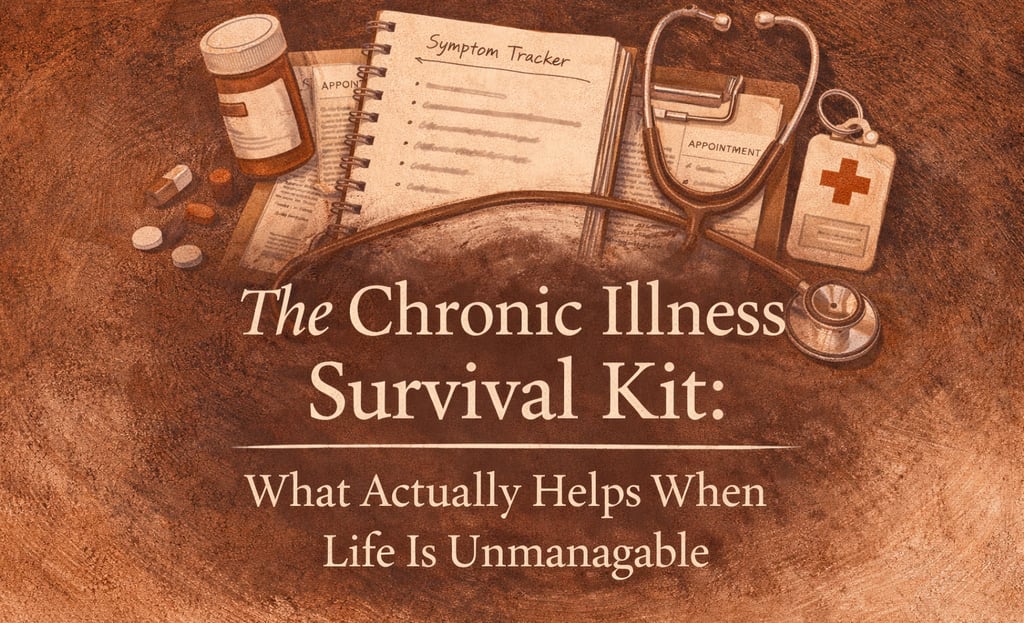
The Chronic Illness Survival Kit: What Actually Helps When Life Is Unmanageable
There is a moment many chronically ill people reach that no one prepares you for.
It’s the moment when advice stops helping.
Not because people aren’t trying, but because suggestions—no matter how well-intentioned—assume a level of energy, clarity, and stability you no longer have. They assume your body is predictable. They assume your symptoms are linear. They assume that if you just organize yourself better, rest more intentionally, or think more positively, things will improve.
When you’re living with chronic illness, that assumption can feel like another burden.
This post is not about optimizing your life.
It is about surviving it.
It exists to answer a simpler, more urgent question:
What actually helps when life becomes unmanageable?
Why “Resources” Matter More Than Advice
Advice is abundant. Support is not.
Advice often sounds like:
“Have you tried…”
“You should really…”
“What worked for me was…”
Support looks different.
Support acknowledges that:
Capacity fluctuates
Pain interferes with cognition
Trauma changes how the body responds
You may not be able to do everything consistently—or at all
When your nervous system is overloaded, advice becomes noise. Resources become anchors. Resources do not ask you to feel differently. They help you function as you are.
This is not a list of hacks or productivity tips.
It is a survival framework—built from lived experience, not ideals.
The Difference Between Helpful and Harmful Support
Before talking about what helps, it’s important to name what doesn’t.
Harmful support often includes:
Toxic positivity (“At least…”)
Unsolicited fixes
Minimizing language (“Everyone gets tired”)
Pressure to “stay hopeful”
Advice that assumes recovery is the goal
Helpful support:
Reduces decision-making
Validates fluctuation
Respects limits
Adapts to changing needs
Does not require explanation or performance
The goal is not to fix you.
The goal is to support you staying.
The Core Survival Categories
When life feels unmanageable, support needs to be layered. No single tool does everything. The most effective survival kits include multiple kinds of support, used differently depending on the day.
Below are the core categories that matter most.
🧠 Cognitive Support: When Thinking Is Hard
Brain fog is not forgetfulness. It is neurological overload.
On foggy days, tasks that once felt simple—remembering symptoms, organizing information, making decisions—can feel impossible. Cognitive support tools exist to offload that burden.
Helpful resources include:
Symptom trackers that don’t assume consistency
Simple logs that capture trends without detail overload
One-page medical summaries
Pre-written descriptions of common symptoms
These tools matter because they:
Preserve information when memory fails
Reduce the need to repeat yourself
Allow documentation without narration
Create continuity across appointments
Cognitive support is not about control.
It is about conservation.
🩺 Medical Support: When Navigating Care Is Overwhelming
Healthcare is complex even when you are well. When you are sick, it can be destabilizing. Medical support tools reduce friction between you and the system.
Essential resources include:
Appointment preparation sheets
Medication lists with side effects noted
Emergency information or medical IDs
Procedure and surgery planners
Post-appointment summary pages
These resources help by:
Keeping appointments focused
Preventing important details from being forgotten
Supporting advocacy without confrontation
Providing clarity when emotions are high
Medical support tools are especially important for people with:
Complex or rare conditions
Medical PTSD
Multiple specialists
Frequent medication changes
They do not guarantee better care—but they reduce harm.
🛏 Physical Support: When the Body Needs Less From You
Physical support is often misunderstood as “rest more.” Rest matters—but without structure, rest can feel like failure.
Helpful physical support resources include:
Gentle pacing frameworks
Energy budgeting tools
Rest logs that remove guilt
Flare-day planning sheets
Mobility or symptom adaptation plans
These tools help you:
Anticipate limitations without shame
Stop pushing past warning signs
Make rest intentional instead of reactive
Honor your body without measuring productivity
Physical support is not about discipline.
It is about permission.
Permission to stop.
Permission to slow down.
Permission to adapt.
💬 Emotional Support: When the Weight Is Invisible
Emotional support is not always about comfort. Sometimes it’s about language.
Many chronically ill people struggle not because they don’t feel deeply—but because they lack words that accurately describe their experience.
Helpful emotional support resources include:
Language guides for explaining illness
Scripts for setting boundaries
Validation-focused writing prompts
Reflection pages that don’t demand positivity
Guides for processing grief and identity shifts
These resources matter because:
Naming experience reduces isolation
Language replaces shame with clarity
Boundaries protect limited energy
Emotional labor becomes shared, not internalized
You should not have to educate everyone to be understood.
Language tools help carry that weight.
👥 Support System Support: When Others Want to Help (But Don’t Know How)
One of the most overlooked needs in chronic illness is support for the support system.
Loved ones often want to help but default to fixing, advising, or minimizing—because no one has taught them another way.
Helpful resources include:
Caregiver guides
“What to say / what not to say” tools
Hospital stay planning sheets
Delegation lists
Communication frameworks for loved ones
These tools:
Reduce misunderstandings
Protect relationships
Clarify roles during crisis
Remove pressure from the patient to manage everything
Support systems need structure too.
Crisis Resources vs. Stable-Day Resources
Not all tools are useful all the time.
One of the most important things to understand is that different seasons require different supports.
During crisis or flares:
Emergency info
Medication tracking
Simple symptom documentation
Delegation tools
Rest-focused resources
During more stable periods:
Reflection tools
Long-term planning
Advocacy preparation
Education resources
Community engagement
You are not failing if you can’t use everything.
Resources are meant to be available, not mandatory.
Building Your Own Survival Kit
You do not need a perfect system.
You do not need to use every tool.
You do not need to organize everything at once.
Start small.
Ask yourself:
What is hardest for me right now?
What would reduce effort today?
What would help future-me?
Your survival kit might be:
One symptom tracker
One medical summary
One boundary script
One trusted support person
That is enough.
You are allowed to:
Use tools inconsistently
Abandon what no longer helps
Change systems as your body changes
Build something imperfect
Survival does not require optimization.
A Final Reminder: Survival Is Not Failure
If you are reading this while overwhelmed—while behind, exhausted, or grieving—please hear this clearly:
Needing support does not mean you are weak.
Using resources does not mean you are giving up.
Building a survival kit does not mean you have failed to thrive.
It means you are responding realistically to what your life requires.
This category exists to offer support that does not judge, pressure, or minimize. Take what helps. Leave what doesn’t. Come back when you need to.
You are not meant to manage this alone.
And surviving—exactly as you are—is more than enough.
Rarely Ordinary Collection
Gentle strength, rare beauty, and advocacy-inspired design.
rarelyordinarycollection@gmail.com
© 2026 Rarely Ordinary Collection. All rights reserved.
Rarely Ordinary Collection is committed to providing an accessible experience for all visitors. If you encounter barriers, please contact us so we can improve.