
How to Support Someone With Chronic Illness Without Trying to Fix Them
Loving someone with chronic illness can be confusing, overwhelming, and deeply emotional. This post offers practical tools, supportive language, and honest guidance for caregivers, partners, family members, and friends—without trying to fix what cannot be fixed. It’s about learning how to show up, listen, and support with compassion, respect, and presence.
TOOLS FOR THOSE WITH CHRONICALLY ILL LOVED ONES
Baylie Phillips
2/28/20264 min read
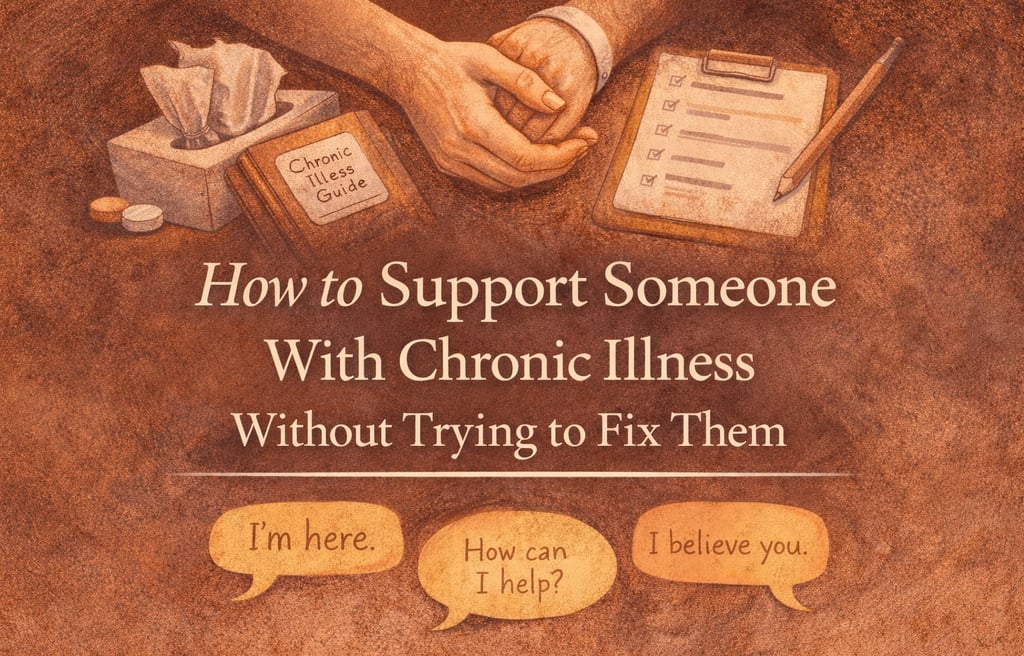
How to Support Someone With Chronic Illness Without Trying to Fix Them
If you love someone with chronic illness, you have likely felt this tension:
You want to help.
You want to ease their pain.
You want to do something—anything—that makes this better.
And yet, no matter how hard you try, nothing seems to fix it.
This post exists to gently shift that expectation.
Because chronic illness is not a problem you solve.
It is a reality you learn to live alongside.
Supporting someone with chronic illness is not about having the right answers. It is about learning how to stay—without minimizing, rescuing, correcting, or disappearing when things get hard.
This guide is not about perfection.
It is about presence.
Why “Fixing” Feels Like Love (And Why It Often Hurts)
Most people are taught that love is action-oriented.
When someone is hurting, we:
Offer solutions
Suggest treatments
Look for causes
Share what worked for someone else
Try to stay positive
These instincts are not wrong. They come from care, fear, and a desire to reduce suffering.
But chronic illness breaks the “fix-it” model.
When pain is ongoing, unpredictable, and not curable, repeated problem-solving can unintentionally communicate something painful:
If we just tried harder, this wouldn’t still be happening.
To someone living inside a sick body, this can land as:
Minimization
Pressure
Blame
Emotional abandonment when fixes don’t work
What helps instead is learning the difference between acute problems and chronic realities.
Chronic illness does not need solutions. It needs support that can exist without resolution.
What Chronically Ill People Actually Need
This may surprise you.
What most chronically ill people need is not more advice—it is less explaining.
They need:
To be believed without proof
To be listened to without interruption
To be supported without being corrected
To be allowed to change plans without guilt
They are already managing their bodies constantly. They are already researching, tracking, adapting, and advocating. They do not need to be coached through their own survival.
What they often need instead is emotional safety.
Safety looks like:
Not being rushed toward positivity
Not having pain reframed as opportunity
Not having exhaustion questioned
Not being compared to others
Support is not about doing more. It is about doing less harm.
What Not to Say (And Why It Hurts)
Words matter deeply when someone is already carrying so much.
Many commonly used phrases are meant to comfort—but instead isolate.
“At least…”
This phrase unintentionally minimizes pain by comparing it to something worse.
What it says instead:
Your suffering could be invalidated
Gratitude should replace grief
“Have you tried…”
This implies the person hasn’t already exhausted options.
What it says instead:
You might be responsible for your illness
If you just did the right thing, this would improve
“You’re so strong”
This can feel like praise—but it often removes permission to be tired.
What it says instead:
You don’t get to fall apart
Your pain must remain inspirational
“Everything happens for a reason”
This can be deeply alienating.
What it says instead:
Your suffering must serve a purpose
Meaning should replace acknowledgment
Avoiding these phrases isn’t about being perfect. It’s about choosing humility over reassurance.
What To Say Instead (Language That Supports Without Taking Over)
You do not need the perfect sentence. You need honest presence.
Here are phrases that often help:
“That sounds really hard.”
“I believe you.”
“You don’t have to explain this to me.”
“I’m sorry you’re dealing with this.”
“How can I support you today?”
“It makes sense that you’re tired.”
These statements:
Validate without fixing
Acknowledge pain without centering yourself
Leave room for the person to lead
Sometimes the most supportive thing you can say is nothing—just staying.
Practical Ways to Help (Without Overstepping)
Support is most effective when it reduces burden rather than creating new emotional labor.
🩺 Medical Support
Helpful actions include:
Attending appointments if invited
Taking notes so they don’t have to
Helping track medications or symptoms
Handling logistics (scheduling, driving, paperwork)
Always ask first. Support should feel collaborative, not invasive.
🏠 Daily Life Support
Chronic illness affects everyday functioning in invisible ways.
Practical help might include:
Meal prep without pressure
Running errands
Helping with household tasks
Managing shared responsibilities during flares
The key is consistency, not intensity. Small, reliable support matters more than grand gestures.
🧠 Cognitive & Emotional Support
Brain fog and fatigue make decision-making exhausting.
You can help by:
Offering choices instead of open-ended questions
Respecting changes in plans
Checking in without expecting updates
Allowing silence without interpreting it as withdrawal
Support does not require constant conversation. It requires attunement.
Supporting Autonomy: Help Without Taking Control
One of the hardest balances is helping without taking over. Chronic illness already strips autonomy. Support should not add to that loss.
Ways to protect autonomy:
Ask before acting
Accept “no” without argument
Let the ill person set the pace
Avoid speaking for them unless requested
Even when you think you know what’s best, trust matters more than certainty.
Supporting Through Flares, Crises, and Uncertainty
During flares or medical crises, fear escalates for everyone involved.
What helps most in these moments:
Calm presence
Clear communication
Reduced decision-making
Familiar routines
Prepare before crisis when possible:
Discuss emergency preferences
Know where important documents are
Clarify who does what
Respect privacy boundaries
Preparation is not pessimism. It is care.
Caring Without Burning Out
Supporting someone with chronic illness is emotionally demanding.
You may feel:
Helpless
Frustrated
Afraid
Guilty for being tired
These feelings do not make you selfish. They make you human.
Sustainable support requires:
Boundaries
Shared responsibility
Honest communication
Space for your own needs
You cannot pour from an empty cup—but you also don’t need to disappear to refill it.
Caring is not martyrdom.
It is partnership.
Letting Go of the “Old Version” of Support
Many people grieve the support roles they expected to play.
You might have imagined:
Fixing things
Helping them “get better”
Being the solution
Chronic illness asks something different.
It asks you to:
Stay without resolution
Love without guarantees
Support without control
Grieve alongside—not instead of
This is not lesser love. It is deeper love.
Community: You’re Not Alone in Learning This
If you are reading this and realizing you’ve said the wrong thing before—please know this:
You are not being judged here.
Most harm comes from lack of guidance, not lack of care.
Learning how to support someone with chronic illness is a process.
It involves listening, adjusting, apologizing, and staying curious.
That willingness matters more than getting it right every time.
A Final Truth
You do not need to understand chronic illness fully to support someone living with it.
You do not need to fix their body.
You do not need to make sense of everything.
You do not need perfect words.
You need presence.
You need humility.
You need consistency.
And sometimes, the most loving thing you can offer is simply this:
“I’m here. I’m not going anywhere. You don’t have to do this alone.”
That is support.
And it matters more than you know.
Rarely Ordinary Collection
Gentle strength, rare beauty, and advocacy-inspired design.
rarelyordinarycollection@gmail.com
© 2026 Rarely Ordinary Collection. All rights reserved.
Rarely Ordinary Collection is committed to providing an accessible experience for all visitors. If you encounter barriers, please contact us so we can improve.